Domesticated dogs are used to detect a variety of odors for a variety of purposes: illicit narcotics, explosives, human-scent tracking and identification, cancer, and COVID-19. Although we know a great deal about how dog’s sense of smell works, we know little about how the effects of artificial selection (breeding) have influenced a dog’s ability to gather scent and then detect odor at the lowest concentrations possible.
Currently, the Waldrop Lab has a grant funded through the Office of Naval Research focused on studying this problem in collaboration with Lauryn DeGreeff at Florida International University.
Visualizing odor plumes
Odor plumes in air are difficult to visualize and therefore to understand intuitively. We’re working to provide the dog-training community better resources for learning about how odor travels in air.
This video and others are available for use in not-for-profit presentations. Please credit Lindsay Waldrop at https://waldroplab.com. For this video and others, please see the following links for downloading. (fps stands for frames per second.)
Dog 1 sniffing water vapor at 500 fps (mov) (Featured above)
Dog 2 sniffing water vapor at 500 fps (mov)
Water vapor at 500 fps (mov)
Water vapor at 1000 fps (mov)
Dog skull morphology
Our currently funded work focuses on how the skull shape of dogs may affect their ability to detect odors of interest. We have scanned skulls from various museum collections (including the Los Angeles Co. Natural History Museum, the American Natural History Museum, and the Yale Peabody Museum) to learn more about how shape influences odor capture.
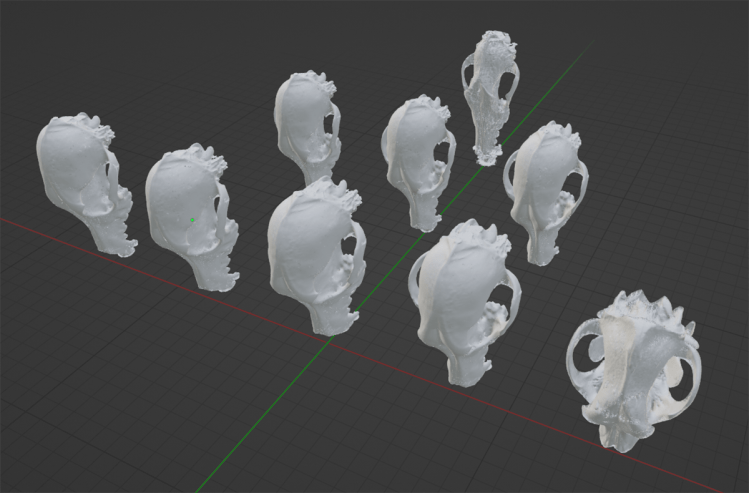
See and use the scans on MorphoSource.
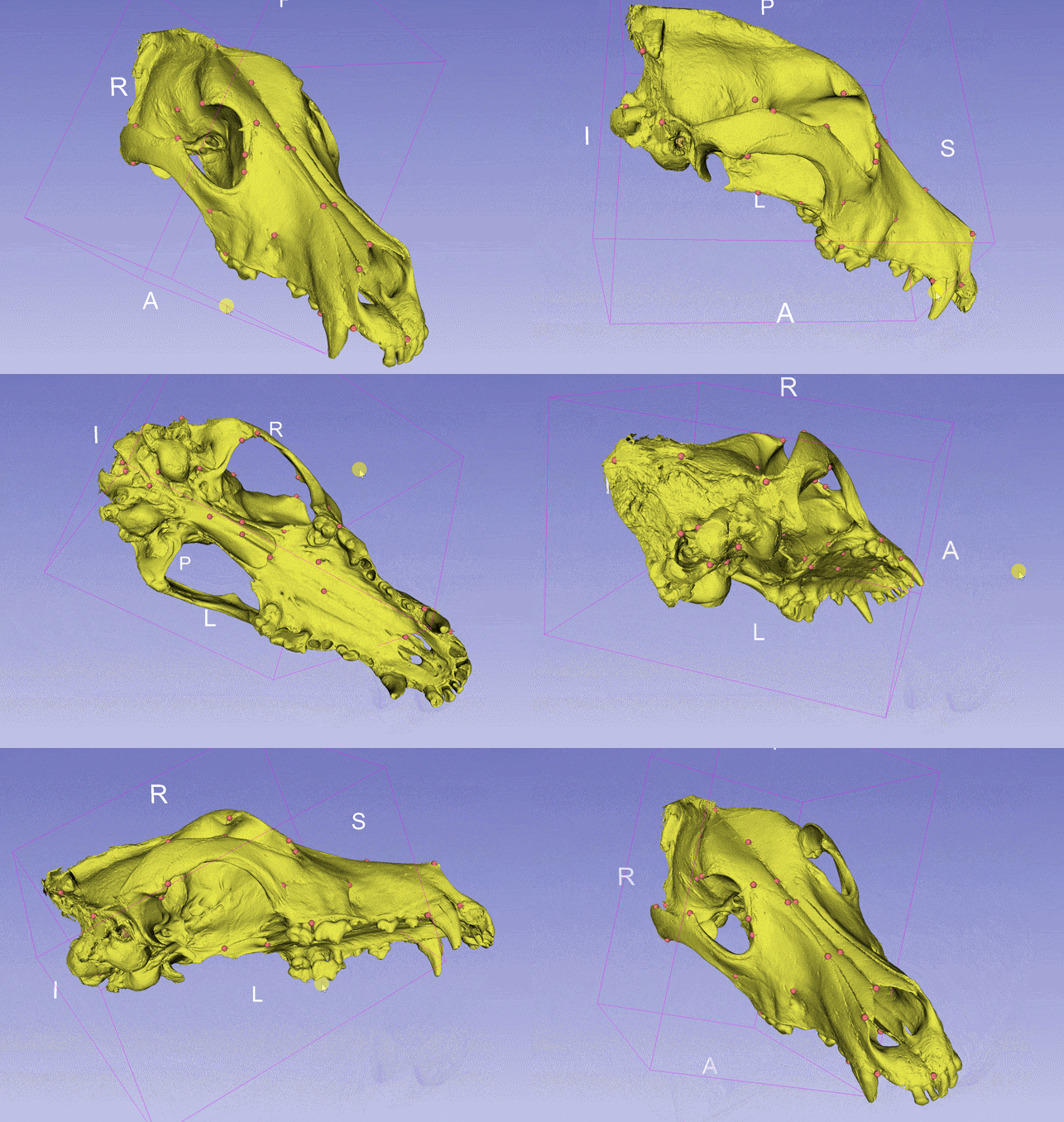
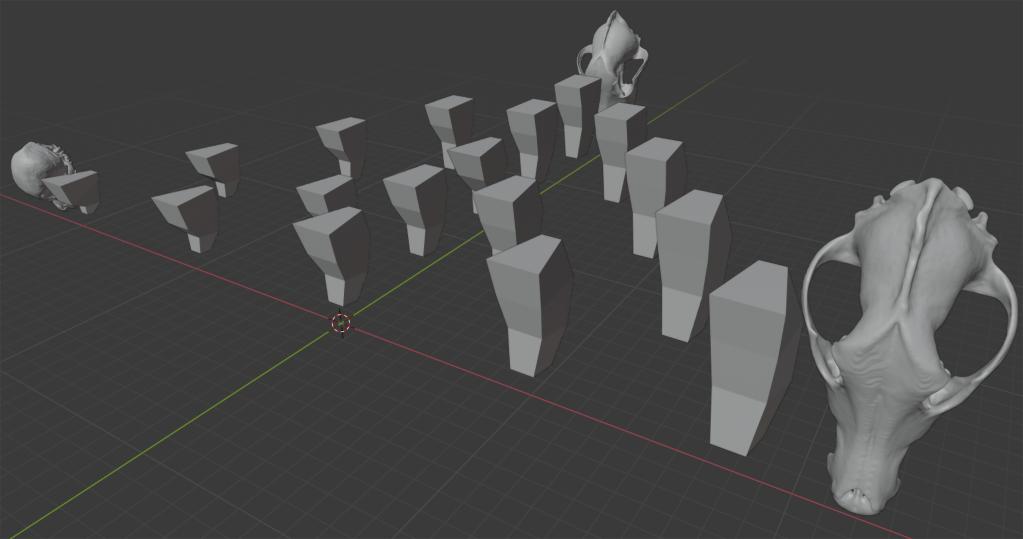
In order to model the transport of odor through nasal passages, Dr. Nicholas Hebdon is developing a parameterized model of the skull to work with computational fluid dynamics modeling software.
We are using commercial computational fluid dynamics software ANSYS Fluent to model flow inside the nasal passageways to estimate odor-capture performance.
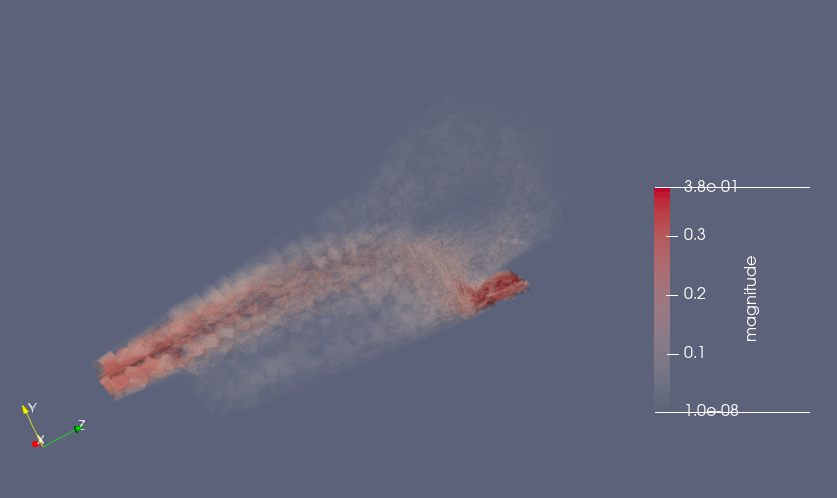
Study of behavior during detection tasks
We are investigating how movement and behavior of dogs changes with training at detection tasks, developing a formal description of behavior (ethogram) and movement analysis (kinematics) for detection tasks in sport-trained and operational dogs. We are currently trialing sport and operational dogs to learn more about how behavior and movement are influenced by training and the physical properties of target odors.
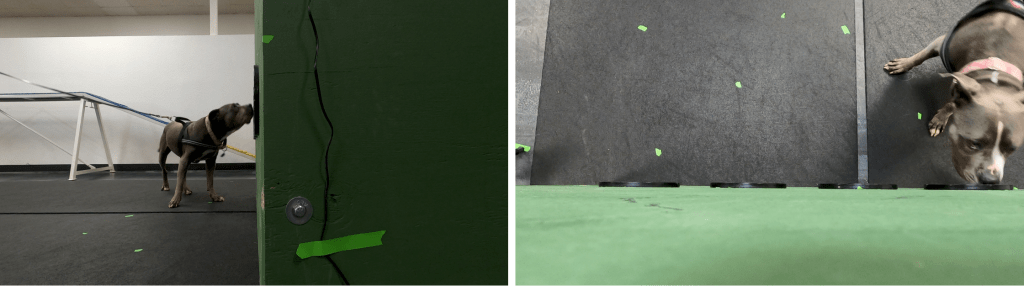
If you are in Southern California and would be interested in participating in ongoing detection dog research, please contact us!
Publications
- K.B. Sloan, M.N. Maughan, C.E. Sharpes, R.R. Greubel, S.F. Gallegos, A.E. Miklos, L.D. Wal- drop. The Manipulation of Odor Availability of Training Aids used in Detection Canine Training. 2025. Frontiers in Allergy 5, DOI: 10.3389/falgy.2024.1445570. Full text (Open Access).
- L. Burnett, N. Hebdon, P. Stevens, M. Moljo*, L.D. Waldrop, L. DeGreeff. 2024. Dog sniffing biomechanic responses in an odor detection test of odorants with differing physical properties. Journal of Animal Science. 102:skae353. DOI: 10.1093/jas/skae353. Full text.
- D. Mejia, L. Burnett, N. Hebdon, P. Stevens, A. Shiber*, C. Cranston*, L. DeGreeff, L.D. Wal- drop. 2024. Physical properties of odorants affect behavior of trained detection dogs during close-quarters searches. Scientific Reports 14: 4843. Full text (Open Access).
* undergraduate researchers
 Waldrop Lab